A vehicle parks where it shouldn’t. You call a tow company. The tow happens. Then the vehicle owner disputes it and wins, because the signs didn’t meet California’s requirements. That scenario plays out more often than property managers expect.
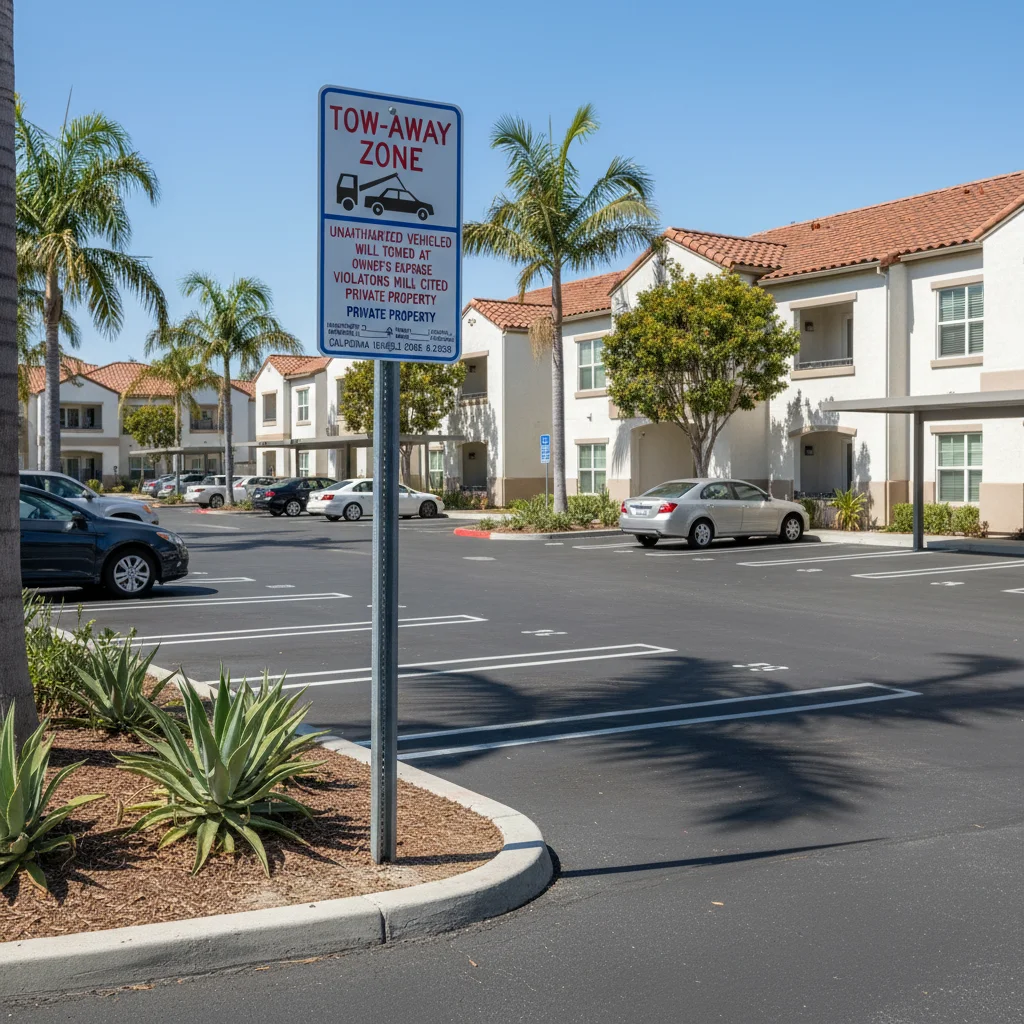
California Vehicle Code 22658 governs private property towing statewide. Our deep-dive on CVC 22658 covers the full process. This post covers the signs.
This is general information about a public statute, not legal advice. For a specific situation, talk to a California attorney.
What CVC 22658 actually requires on the sign
Here is the operative language of CVC 22658(a)(1), which is short enough to read in full:
There is displayed, in plain view at all entrances to the property, a sign not less than 17 inches by 22 inches in size, with lettering not less than one inch in height, prohibiting public parking and indicating that vehicles will be removed at the owner’s expense, and containing the telephone number of the local traffic law enforcement agency and the name and telephone number of each towing company that is a party to a written general towing authorization agreement with the owner or person in lawful possession of the property.
That’s the whole requirement. Break it into its parts:
Size. Not less than 17 inches by 22 inches. Roughly a tabloid sheet.
Lettering. Not less than one inch in height.
Placement. In plain view at all entrances to the property. Every vehicle entrance, not just the main one.
Four text elements:
- A statement prohibiting public parking
- A statement that vehicles will be removed at the owner’s expense
- The telephone number of the local traffic law enforcement agency
- The name and telephone number of each towing company party to a written general towing authorization agreement with the property
That fourth element is the one properties most often get wrong, and the third is the one they most often leave off entirely.
Sign rules that are not in the statute
A lot of guidance circulating online, including things we’ve published ourselves in the past, states requirements CVC 22658 does not contain. If you’ve been told any of the following is legally mandatory, it isn’t:
- A phone number answered 24 hours a day. The statute requires a telephone number. It says nothing about staffing it around the clock.
- Hours of enforcement printed on the sign. Not required.
- A specific mounting height, such as between 4 and 8 feet. Not required. The standard is “in plain view.”
- Sign lighting or night legibility. Not required by this statute.
- A separate sign inside each zone of the lot. Not required.
- A cost disclosure for properties with 25 or more units. No such subparagraph exists.
- Printing the statute number on the sign. Not required.
- A minimum time signs must be posted before a tow. No such period exists in CVC 22658.
None of these are bad ideas. A legible, well-lit sign with clear enforcement hours prevents disputes, and if your local ordinance or your CC&Rs require more, follow them. Just don’t treat convention as statute, and don’t let a vendor sell you compliance against a rule that isn’t real.
One genuine nuance people do miss: CVC 22658(a) lists four alternative grounds for removal, and signage is only the first. A notice of parking violation issued 96 or more hours earlier, an inoperable vehicle 24 or more hours after law enforcement was notified, and a lot improved with a single-family dwelling are each independent grounds. Signage matters because it’s the ground almost every apartment, HOA, and retail property relies on.
What actually undermines a tow
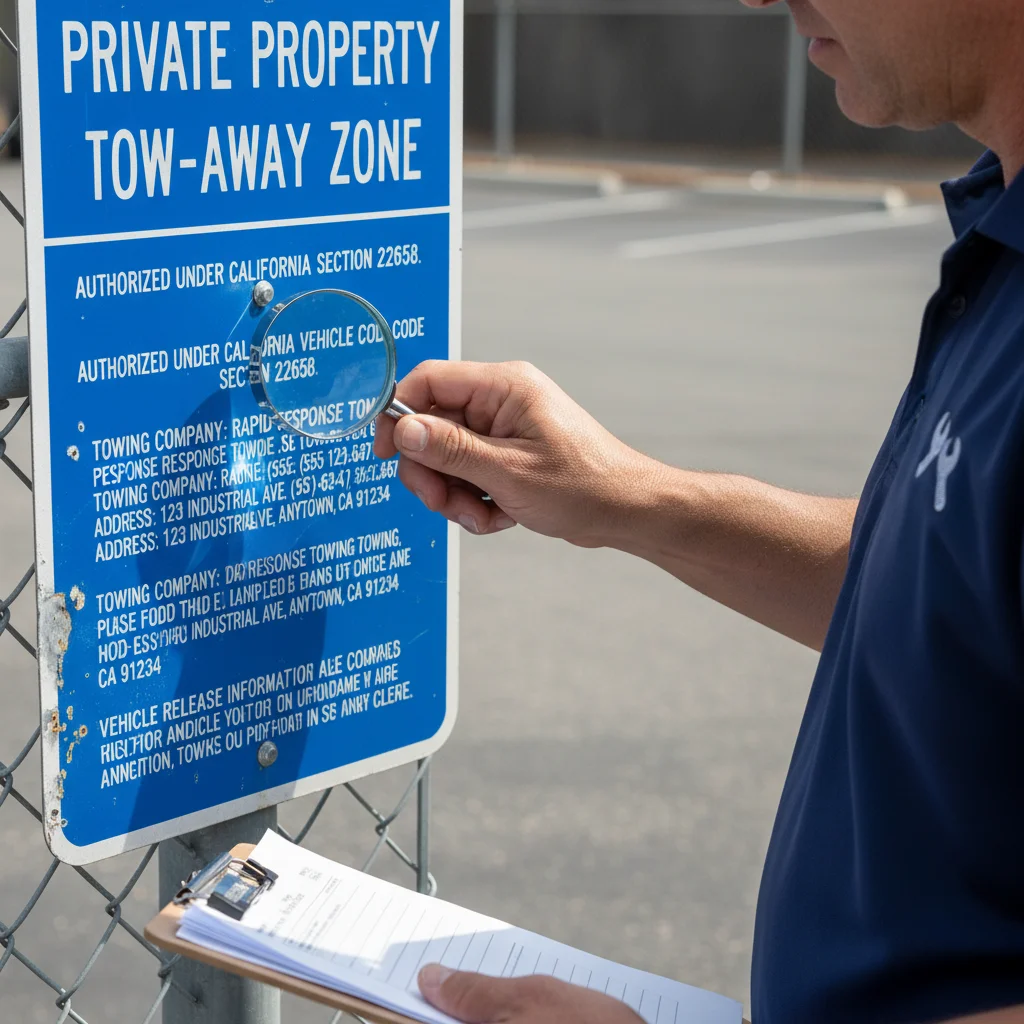
Missing the law enforcement phone number
The most common real defect we see. A sign carries the tow company’s name and number, looks professional, and omits the local traffic law enforcement agency number the statute names explicitly.
Outdated tow company information
A property switches towing companies. The old vendor’s name and number stay on the signs. Months later a vehicle owner disputes a removal and points out the company named on the sign isn’t the company that towed the car. The statute ties the sign to the company under written general towing authorization agreement with the property.
Undersized signs or lettering
Under 17 by 22, or lettering under one inch, is non-compliant on the face of the statute. Bring a tape measure rather than eyeballing it.
Faded or obscured signs
The statute requires the sign be displayed “in plain view.” A sun-bleached phone number or a graffiti-covered panel is a real argument that nothing was in plain view. San Diego’s UV exposure is hard on signage, so inspect regularly and replace on a schedule rather than waiting for a dispute.
A missed entrance
One compliant sign at the front entrance doesn’t cover a secondary or alley entrance. If a vehicle entered through an unposted entrance, the owner has a straightforward argument the tow lacked a basis.
HOA and apartment realities
Signs beat CC&Rs. Boards sometimes assume recorded rules substitute for physical signage. They don’t. The statute requires physical signs at all entrances regardless of what the governing documents say.
Guest parking. Guest lot disputes are common. Restrictions communicated only through newsletters or verbal rules don’t create a towing basis. Whatever the property enforces should be legible to a driver at the entrance.
Written authorization is separate from signage. Compliant signs give you a ground to tow. They don’t replace CVC 22658(l), which requires written authorization from someone who is generally present at the time of removal and verified the violation. There’s a narrow exception for residential rentals of 15 or fewer units with no onsite staff, where a tenant verified the violation and requested the tow from their own assigned space in writing. Note the direction of that rule. It’s an exception for small properties, not an extra duty for large ones.
Don’t hand over discretion. Under CVC 22658(l)(1)(E)(i), standing authorization for a tow company to remove vehicles at its own discretion is limited to vehicles within 15 feet of a fire hydrant, in a fire lane, or blocking an entrance or exit.
How to audit your signs
Walk every entrance. Drive in from every vehicle access point. Can you read the sign from the driver’s seat without stopping?
Measure. At least 17 by 22 inches. Lettering at least one inch.
Check all four text elements, especially the local traffic law enforcement phone number.
Verify the tow company named is your current vendor, and that the number reaches them.
Fix deficient signs before towing again. Towing without a valid basis exposes the property, not just the tow company. A party that violates CVC 22658 can face a fine of up to $2,500 and up to three months in county jail, and can be civilly liable to the vehicle owner for four times the amount of the charges involved.
Photograph each sign after installation, date-stamped, showing placement and legibility. If a tow is disputed later, that’s your record.
When to call us
If you manage a residential or commercial property in San Diego County and want a towing partner who reads the statute rather than repeating folklore about it, that’s what our private property towing service is built for. We’ll review your signage before we hook a vehicle, and we’ll tell you plainly which of your signs are non-compliant and which are simply below best practice. Call us at (858) 923-5787.
Private property towing cluster: Get an illegally parked car towed from your San Diego property · Legal compliance steps before you authorize a tow · CVC 22658 full statute explainer · Was your car wrongfully towed from private property? · Getting your car out of impound in San Diego