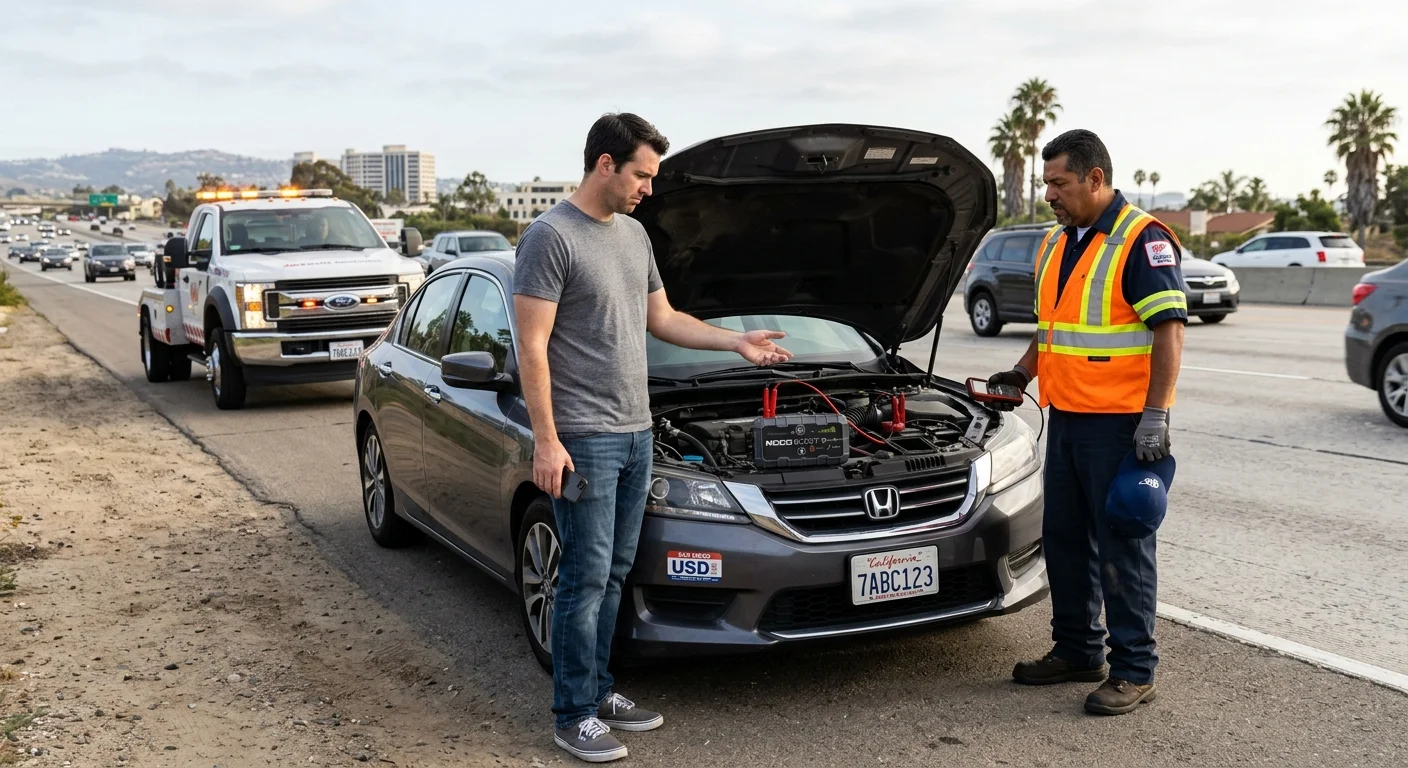
When your car jump starter fails, one more roadside attempt may be reasonable. Choose a tow instead when repeated attempts fail, the vehicle shows warnings or damage, or it needs professional diagnosis. Your location also matters, especially on a freeway shoulder or inside a restricted garage.
What a failed jump attempt can tell you
A failed attempt confirms one thing: the car didn’t start with that setup. It doesn’t confirm that the battery is the only problem. The portable unit may not have been ready, its connection may have failed, or the car may have another fault.
Pay attention to what happened without taking anything apart. Did the dashboard remain dark? Did you hear clicking? Did the engine turn without starting? Did it start briefly and stop again? Share that sequence with the person handling your call.
Check the jump starter’s display for its charge level or warning symbol. Those indicators vary by model, so use the device manual for their meaning. Don’t bypass a warning or repeat attempts beyond the manufacturer’s directions.
The setting adds useful context. A disabled car in a Mission Valley parking lot presents a different job from one on I-8 near Alpine. Downtown garages may have height limits, narrow turns, access gates, or underground levels. Freeway locations need an exact direction and nearby exit.
If the car won’t start in a shopping center, office garage, or apartment lot, our guide to a car that won’t start in a parking lot covers the location details worth gathering. Those details help dispatch decide whether to arrange roadside service or towing.
When another roadside jump may still make sense
A professional roadside jump may make sense after one unsuccessful attempt with a personal car jump starter. That’s especially true when the vehicle has no visible damage, the device displayed an unclear warning, or you aren’t confident it made a proper connection.
This isn’t a promise that another jump will work. The operator sent out can assess the accessible starting points, vehicle information, and symptoms at the scene. If the car starts, follow the operator’s guidance and arrange any needed inspection. If it still doesn’t start, towing may become the practical next step.
Avoid turning the roadside visit into repeated guesswork. Tell dispatch how many attempts you made and what changed between them. Mention whether the lights became brighter, the engine made a different sound, or nothing happened. Don’t open sealed components or attempt repairs that require training.
A search for a “car jump starter near me” may surface stores and battery products. That doesn’t solve every no-start condition. If you need someone at the vehicle, request roadside assistance or read what to expect from a jump-start service near you.
Preparation still helps. NHTSA’s roadside guidance recommends carrying items such as a phone and charger, flashlight, jumper cables, water, and a first-aid kit. Keep the phone available so the dispatched operator can reach you about access or location details.
Signs the car should be towed instead
Choose towing when another jump would only delay a needed inspection. Repeated failed attempts are the clearest signal. A tow also makes sense when the engine turns but won’t start, the car starts and stops again, or the jump starter reports a warning you can’t resolve through its manual.
Request a tow when you notice collision damage, smoke, unusual heat, a strong burning odor, or leaking fluid. Don’t keep attempting a jump around visible damage. Tell dispatch what you observed so the operator can prepare for the vehicle’s condition.
Dashboard warnings matter too. Record the exact warning text or illuminated symbol if you can do so safely. A photo may help you describe it accurately. Don’t clear messages or disconnect components just to see whether the warning disappears.
Location can settle the roadside jump start or tow decision. A car stopped near moving traffic on I-5, I-15, SR-94, or SR-163 leaves little room for trial and error. A parking structure may require equipment that fits its clearance. Tell dispatch about ramps, gates, wheel stops, and the level where the car sits.
Use emergency towing when the vehicle needs to be moved rather than tested again. Quick Tow SD refers the request to an independent operator. The operator evaluates the vehicle, performs the work, and handles payment directly with you.
What to tell the roadside dispatcher
Start with your exact location. On a freeway, provide the route, travel direction, nearest exit, and any visible marker. In a garage, give the property name, level, stall, entrance, height limit, and gate instructions. A dropped map pin can help when nearby addresses point to the wrong entrance.
Next, describe the vehicle:
- Year, make, and model
- Gas, diesel, hybrid, or electric
- Whether the dashboard lights come on
- What sound the vehicle makes
- How many jump attempts were made
- What the car jump starter displayed
- Any warning message, odor, heat, leak, or visible damage
- Whether the keys are present
- Any damaged or locked wheel
- Your preferred destination
Give the events in order. “The dash lit up, the engine clicked once, and the jump pack showed a warning” is more useful than “the battery is dead.” Describe what you observed without diagnosing the cause.
Tell dispatch if the car blocks a travel lane, garage ramp, driveway, loading area, or parking exit. Mention passengers, pets, access restrictions, and whether property staff must open a gate.
Quick Tow SD’s phone line takes calls 24 hours a day. We don’t publish a blanket arrival time because each location and operator is different. The operator taking the job provides an arrival estimate for your exact location. The operator also sets the price, so confirm the proposed service and charge before dispatch.
For a broader view of local service areas and common requests, see our San Diego towing service overview.
Where to send a car that still won’t start
Choose the destination before the operator arrives when possible. That could be your regular repair shop, a dealership, or another facility prepared to inspect the vehicle. Call the destination first. Confirm that it accepts the vehicle, has space, and can receive it at the expected drop-off time.
After-hours access needs special attention. A locked shop may have a designated drop area, key box, or no unattended delivery option. Don’t assume the operator can leave a vehicle outside a closed business. Ask the destination where the vehicle and keys should go.
Distance also shapes the decision. A breakdown in Oceanside with a shop in Chula Vista is different from a short move within North Park. Tell dispatch the full destination address from the start. The operator can then review the complete request before accepting it.
If you don’t have a shop yet, say that clearly. You can compare nearby options and call them yourself before selecting a destination. Confirm their current hours and intake process directly because those details can change.
Quick Tow SD doesn’t operate a repair shop, storage yard, or impound lot. We connect callers throughout San Diego County with independent towing operators. The operator sent out transports the vehicle to the destination you approve.
When to call us
Call when repeated jump attempts fail, the vehicle shows damage or warnings, or it needs transport to a repair facility. We’ll match the request with an independent professional towing operator serving your location. Call (858) 923-5787 to reach dispatch.