TL;DR
- Check five things by December 1: battery age (replace after 3 to 5 years), tire tread and pressure, windshield wipers, coolant level, and washer fluid.
- Build a trunk emergency kit for about $150: jump pack or cables, flashlight, emergency blanket, water, protein bars, reflective triangle, tire gauge, and phone charger.
- San Diego winter hazards include marine layer fog on PCH, first-rain hydroplaning, occasional snow on Palomar and Sunrise Highway, pothole season in January, and earlier sunsets.
- A marginal battery that survived summer often fails on a cool December morning. Get it load-tested free at AutoZone or O’Reilly before the season.
San Diego doesn’t do winter like the Midwest, but our winters still break down cars. Marine layer fog on PCH, overnight lows in the 30s up the I-15 corridor, occasional snow on Palomar and Sunrise Highway, and the rainy-day pothole field that shows up every January on city streets. Here’s how to get ahead of it.
The five things to check by December 1
1. Battery age. Most lead-acid car batteries last 3-5 years in San Diego. If yours is past year three, get it load-tested at a parts store (free at AutoZone, O’Reilly, Costco). A marginal battery that survived summer often fails on a cool December morning when the oil is thick.
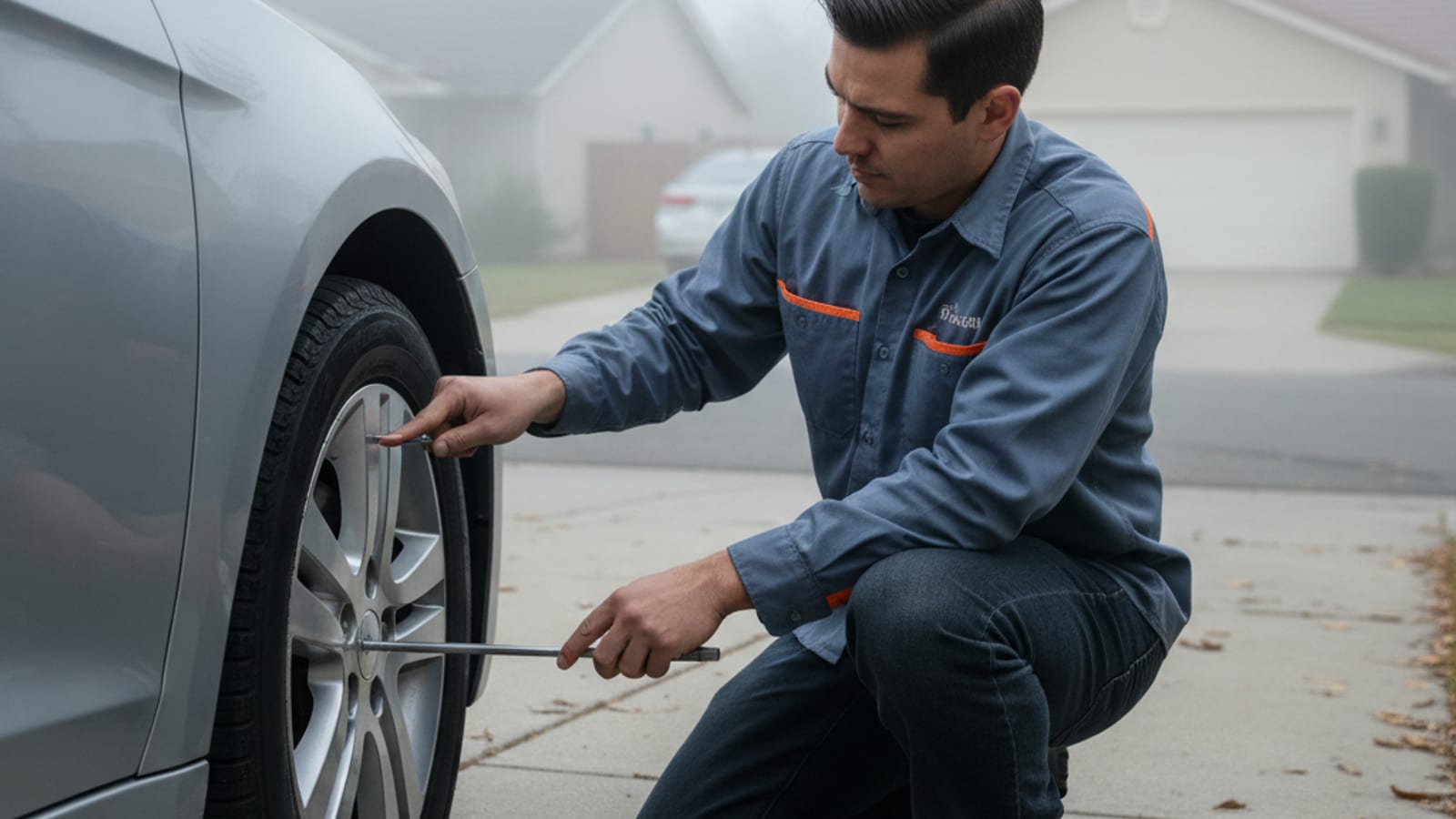
2. Tires. Check tread with a quarter - Washington’s head should be partially covered. Below that, tread is worn. Also check pressure; air contracts in cold weather, and SD pressure drops noticeably from October to January. Underpressure tires wear poorly, hydroplane on wet roads, and can strand you with a sidewall blowout.
3. Windshield wipers. A California wiper that hasn’t been replaced in a year is streaking, skipping, or worse. First big rain of the season, you’ll notice. $25 each side at Autozone; 10-minute install.
4. Coolant level and condition. Check the overflow reservoir. If the coolant is muddy brown or there’s visible rust, drain and refill is due. Older cars that rarely see freezing sometimes get ignored - bad idea if you drive to Julian or Big Bear.
5. Washer fluid. Topped up, with winter-rated fluid (doesn’t freeze at low temps). Relevant if you drive up to Mount Laguna or Palomar on cold mornings.
What should go in your winter emergency kit?
Everything below fits in a milk crate in the trunk and costs about $150 total:
- Jumper cables (heavy-duty, 8 gauge or better) OR portable lithium jump pack (NOCO, Antigravity, Halo; ~$90)
- LED flashlight with spare batteries
- Roll of duct tape
- Emergency blanket (foil space blanket; $5)
- 2 sealed water bottles (rotate yearly)
- Protein bars or trail mix (rotate quarterly)
- Small first-aid kit
- Reflective emergency triangle
- Tire pressure gauge
- Ice scraper (yes, in San Diego - for mountain trips)
- Windshield washer fluid (small bottle for top-off)
- Rain poncho (disposable; $3)
- Phone charging cable + 12V adapter
- Printed list of emergency numbers: insurance roadside, your preferred tow company, family contact. If you’re unsure whether to keep your AAA membership active, see our comparison of AAA roadside assistance in San Diego and the pay-per-use alternative.
What are the winter driving hazards in San Diego County?
Marine layer fog. PCH from Oceanside to Del Mar, and the Mission Bay area, see thick morning fog all winter. Fog cuts visibility to under 100 feet. Drive with low beams (high beams reflect off fog and make it worse), keep distance, and slow down.
Rainy-day hydroplaning. First rain after a dry spell is the most dangerous - oil and rubber have accumulated on the road and make the surface slick. I-5, I-15, I-8 all see major accident spikes during the first hour of a winter rain. Slow 10 mph under the limit, increase following distance, avoid sudden maneuvers.
Palomar, Julian, Alpine, Sunrise Highway. These routes occasionally see snow or ice January through March. Check weather before heading up. CalTrans chain controls activate a few times per year on Sunrise and Palomar. Carry chains if you’re heading to the mountains; rent from any AAA branch or buy from Walmart for $30.
Pothole season. Winter rain exposes pavement weakness; January and February see the highest pothole-damage rates on San Diego freeways. Watch the lane ahead, not just your bumper.
Longer nights. Sunset at 4:50 PM in December means more of your evening commute is in the dark. Headlight bulbs dim over time - if yours look yellow or dim, replace. Cheap insurance.
When should you call a tow in winter?
Same rules as summer, but a few winter-specific scenarios:
- Dead battery on a cold morning. Jump if you have cables or a pack; if the crank is weak even after a jump, call for roadside assistance or a tow to a battery shop.
- Stuck in sand on a beach run. OB and Fiesta Island don’t close in winter; we still handle accident recovery and winch-outs every weekend.
- Mountain breakdown in cold weather. If you break down above 4,000 feet elevation in San Diego County during a cold snap, call for emergency towing sooner rather than later. Walking down from a canyon road in 40°F rain is a bad outcome.
- Hydroplane accident. Minor fender-benders on wet roads are common. If the car is drivable, limp off the freeway; if not, call and we’ll respond with a flatbed for damaged vehicles.
- Fuel-out situations. Pay attention to the gas light; cold weather drops fuel efficiency 5-10% on most cars.
- EV range surprises. Cold weather cuts EV range by 15-30%. EV drivers who cut it close on summer range can find themselves stranded in January. Keep Charge Pro SD’s number saved - they handle mobile EV charging across San Diego County for dead-battery situations where a tow isn’t needed.
Why do car batteries die on cold San Diego mornings?
San Diego’s coldest mornings (5 AM in Escondido, Alpine, Julian, Ramona) can drop to the 30s January through February. A tired battery that held 12.2 volts on an October evening can drop to 11.4 volts overnight - below the crank threshold.
If you’ve had any weak-crank mornings in October or November, don’t wait for a January surprise. Get the battery load-tested.
Fleet and commercial winter prep
For fleets running out of SD County in winter:
- Pressure check all vehicles weekly in December-February
- Battery load test everything with 3+ years of service before December 1
- Wiper replacement as standard Q4 maintenance
- Route drivers on roadside kit contents - not all drivers think to carry water or blankets
- Winter chain requirement training for drivers heading to mountain counties
Fleet accounts can be set up in advance. Call to ask about fleet rates.
Backup plan: the tow company on speed dial
Save (858) 923-5787 in your phone under “Tow” or “Roadside.” Not because we want all the calls, but because:
- The line takes calls 24/7
- Ask for the flat rate on the phone
- Arrival time depends on where you are and what is on the road
- Your insurance roadside coverage can route to us if you have a preference saved
If you get stranded, the saved number is faster than Googling from a shoulder.
Bottom line
San Diego winters aren’t Wisconsin winters - but they still strand cars. Five checks now, a $150 trunk kit, and a tow number in your phone is the whole plan.
Winter towing across San Diego County: We respond to cold-weather breakdowns in Escondido, Alpine, Ramona, Julian, El Cajon, and throughout the county.
Related reading: If winter does strand you on the highway, our freeway breakdown guide covers how to stay safe on the shoulder and what to tell dispatch. Dead battery is the most common winter culprit — how to jump-start a car walks you through it step by step. And for pricing if you do need a tow, see the San Diego tow cost guide.
Frequently asked questions
Does San Diego County get cold enough to kill a car battery?
Yes. Overnight lows in Escondido, Alpine, Julian, and Ramona drop into the 30s in January and February. A battery past its third year that held 12.2 volts in October can drop below the 11.4V crank threshold on a cold morning. Free load testing at AutoZone or O’Reilly takes 10 minutes and catches this early.
Do I need snow chains for driving in San Diego County?
Only if you’re heading to mountain routes like Palomar Mountain, Sunrise Highway, or Julian during winter storms. CalTrans activates chain controls on these roads a few times per year between January and March. Chains run about $30 at Walmart or can be rented from any AAA branch.
What should I keep in my car’s emergency kit?
A solid trunk kit runs about $150: jumper cables or a portable jump pack, LED flashlight, emergency blanket, two water bottles, protein bars, first-aid kit, reflective triangle, tire gauge, phone charger, and a printed list of emergency numbers. Rotate the water yearly and the food quarterly.
When is the most dangerous time to drive in the rain in San Diego?
The first hour of a winter rainstorm after a dry spell. Oil and rubber residue accumulate on the road during dry weeks and create an extremely slick surface when it first gets wet. I-5, I-15, and I-8 all see major accident spikes during this window. Slow 10 mph under the limit and increase following distance.
If you’re already broken down, call us. If you’re planning ahead, save our number for later.