If you need to move a classic, vintage, or exotic car in San Diego, a flatbed tow truck is the only method that keeps all four wheels off the ground and eliminates drivetrain and undercarriage risk. This guide covers the practical details: how open flatbeds differ from enclosed trailers, how soft-strap loading works, what low-clearance ramp extensions do, how to vet a hauler, and what insurance factors matter for high-value vehicles. If you’re ready to book, head directly to classic and exotic car towing in San Diego.
Open flatbed vs. enclosed trailer: which one does your car need?
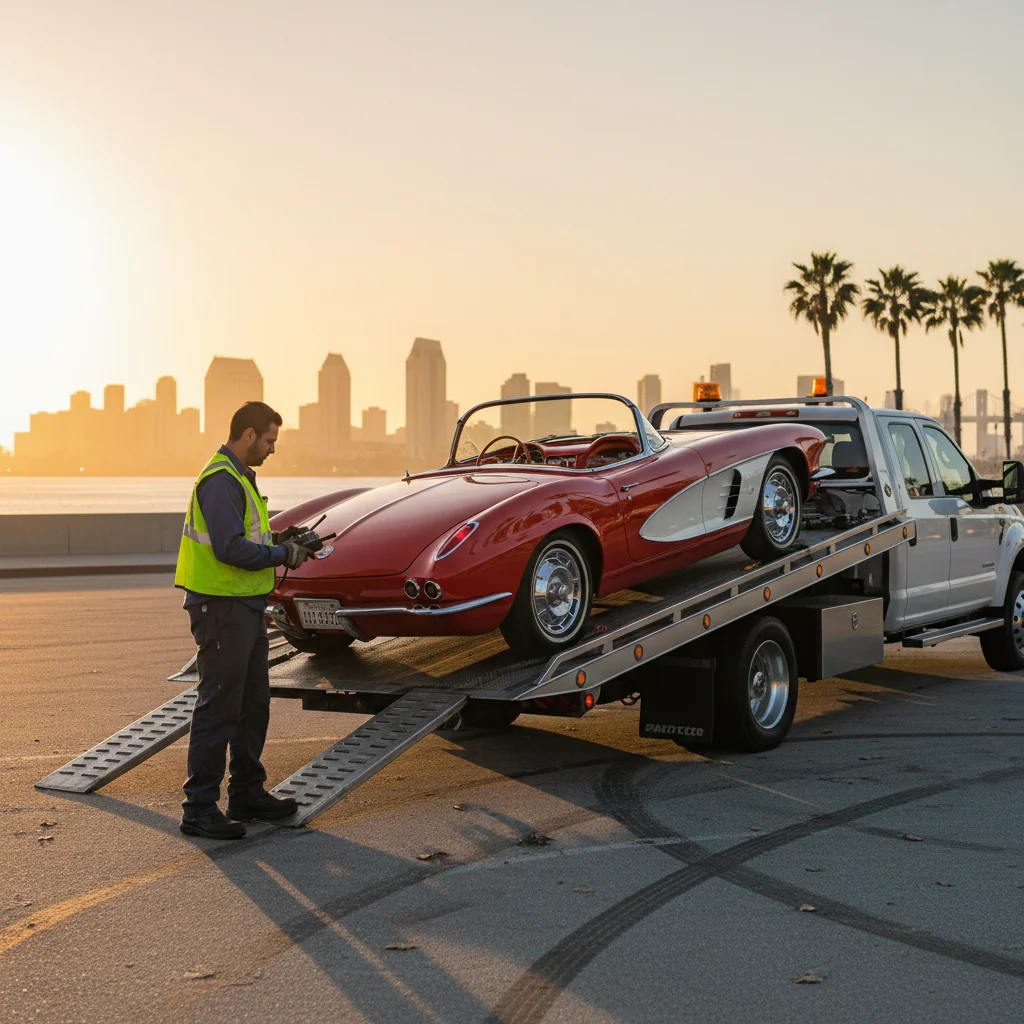
Most specialty towing in San Diego County uses an open flatbed. The bed tilts hydraulically, slides back toward the ground, and the car rolls up a ramp under its own power or via a winch. Open flatbeds handle almost every classic and exotic, from a ‘69 Camaro to a current-gen 911, and they’re faster to load and unload.
An enclosed trailer adds a full shell around the car. It protects against road debris, rain, and UV exposure during the haul. Enclosed trailers are most relevant for:
- Long-distance transport (cross-county or interstate)
- Concours-condition show cars where any dust or moisture matters
- Very high-value exotics where the owner or insurer requires fully enclosed transport
For most San Diego breakdowns and short-haul moves, an open flatbed is the right call. The extra cost of an enclosed trailer adds up fast and the protection benefit is minimal on a 20-mile haul on the 5.
How soft-strap loading actually works
Older tow trucks used chains on the frame or hooks on the suspension. Soft-strap loading is different. Here’s the sequence a trained operator follows:
- The flatbed tilts and extends back to create the lowest possible ramp angle.
- A nylon winch line attaches to the car’s factory tow hook, not to the frame rail or control arm.
- The car is winched up slowly, with the operator watching clearance on the splitter, exhaust, and side skirts at every point.
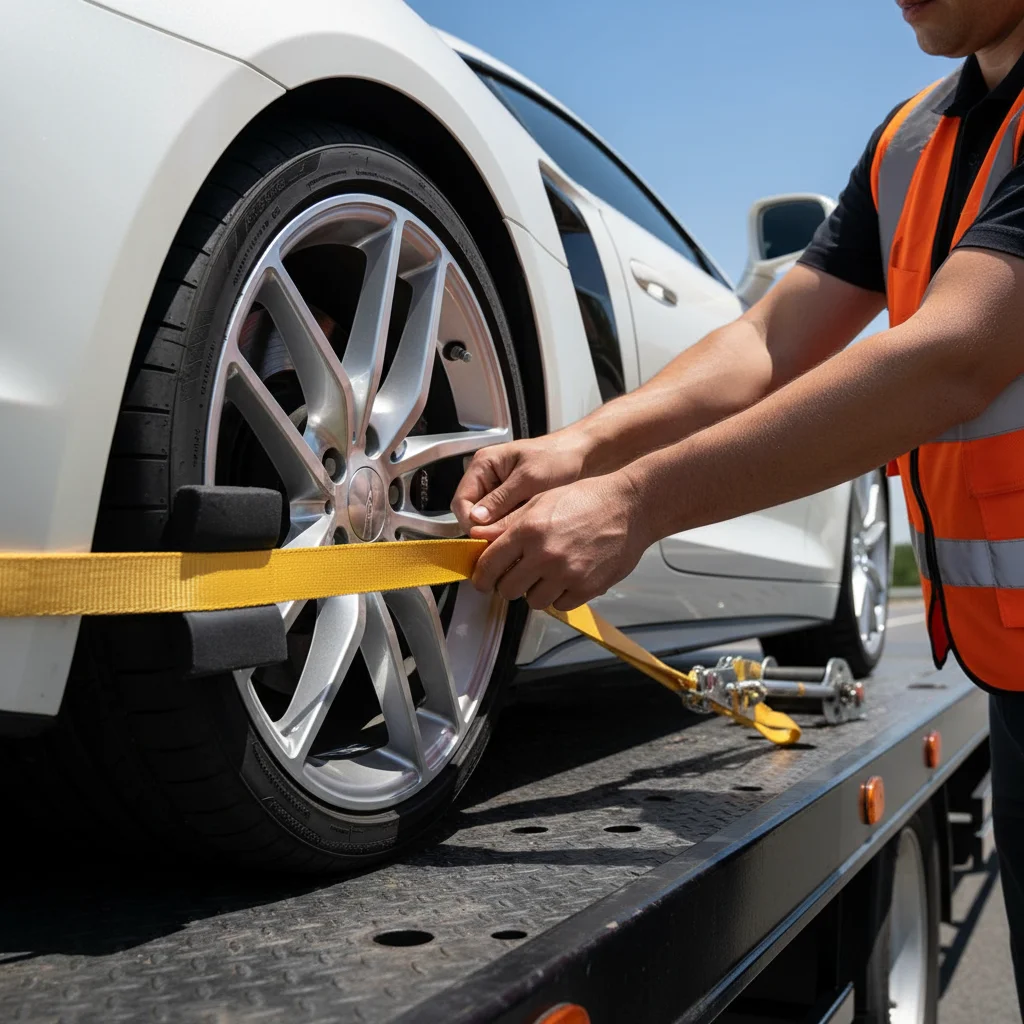
- Once fully on the bed, four wide nylon straps loop over the top of each tire and anchor to the bed’s tie-down rails. The strap contacts rubber, not paint or wheel finish.
- The tie-downs pull the tire into the bed, loading the suspension downward. This is the car’s normal load path, so there’s no stress on bushings or alignment.
Chains or wire cable on the frame are a red flag. They concentrate load on a single point and can scratch or crack the undercarriage. If a hauler doesn’t use soft straps over the tires, that’s reason enough to call someone else.
Low-clearance ramp extensions: when and why they matter
A standard flatbed ramp angle is roughly 10 to 12 degrees. That’s fine for most cars. A stock Ferrari 488 has about 4.3 inches of front ground clearance. A lowered classic or an aggressively built track car can be under 3 inches. At 10 degrees, the leading nose hits the ramp before the front wheels reach it.
Ramp extensions solve this. They’re lightweight aluminum or composite panels that bolt onto the end of the main ramp and drop the approach angle to 5 or 6 degrees. Some operators also use rubber “race ramps” or wooden blocks to split the angle change into two gradual steps. The result: the nose clears by an inch or two even on a dead-low car.
If your car is modified, lowered, or you’re not sure about its clearance, mention that when you call. A prepared operator shows up with extensions already on the truck. An unprepared one will improvise, and improvisation is where paint gets scratched.
What to ask a hauler before you book
Not every tow company that owns a flatbed has experience with specialty vehicles. These questions separate the prepared from the unprepared:
Do you use soft straps over the tires, or chains on the frame? Correct answer: soft straps over the tires only.
Do you carry ramp extensions for low-clearance vehicles? If your car sits below 4 inches, this matters. Get a yes before you commit.
What is your per-occurrence liability limit? Standard commercial towing insurance often caps at $50,000 to $100,000 per vehicle. For a car worth $150,000 or more, that gap is your problem, not theirs, unless you verify in advance.
Does my own agreed-value policy cover in-transit damage? Many classic car insurance policies include transport coverage, but some require you to notify the insurer before the move. Check before the tow, not after.
Insurance and value considerations for classics and exotics
San Diego has a large collector car community, partly because the mild climate lets owners drive year-round instead of storing. That also means the towing situations are more varied, from a 1967 Mustang that won’t start after a show at Del Mar to a recent-model Porsche that hit a pothole on Torrey Pines Road.
Two insurance points worth knowing before you need a tow:
Agreed value vs. actual cash value. Most collector car policies (Hagerty, Grundy, American Collectors) use agreed value, meaning the policy pays the stated amount regardless of depreciation if the car is totaled or damaged. Standard auto policies use actual cash value, which deducts depreciation. If you’re towing a classic on a standard policy, the payout for a towing-related loss may be far less than the car is worth.
In-transit coverage. Some classic car policies explicitly cover damage that occurs while the car is on a flatbed or trailer. Others treat it as excluded or subject to a separate rider. Read the policy or call your broker before the move. If coverage is unclear, photograph the car from all angles before loading.
Why standard wheel-lift towing doesn’t work for these vehicles
A wheel-lift truck grabs the front or rear tires and lifts one end of the car, dragging the other two wheels along the pavement. For a front-wheel-drive commuter car, that’s fine. For a high-value vehicle, it creates several problems:
- AWD drivetrain damage. All-wheel-drive systems are not designed to have two wheels spinning on the ground while the other two are stationary. Running an AWD vehicle this way can damage the center differential and transfer case.
- Low-clearance scraping. When the non-lifted end drags, the undercarriage of a low car comes very close to the pavement, especially over bumps or transitions.
- Suspension stress. Lifting one end of a vehicle by its wheels puts the frame and suspension in a load orientation they were never designed for.
For more detail on how these methods compare, see flatbed vs. wheel-lift towing.
Ready to book?
For a classic, vintage, or exotic vehicle, the practical standard is an open flatbed with soft-strap tie-downs and a trained operator. If your car is lowered or modified, ask about ramp extensions when you call.
To arrange classic and exotic car towing in San Diego, call (858) 923-5787.
Frequently asked questions
Is a flatbed tow truck necessary for classic car towing in San Diego?
Yes, for virtually every classic and exotic vehicle. A flatbed keeps all four wheels off the ground, eliminates drivetrain stress on AWD systems, and protects low-clearance bodywork that a wheel-lift truck would scrape.
What is the difference between an open flatbed and an enclosed trailer for a vintage car?
An open flatbed exposes the car to the elements but is faster, less expensive, and works well for local moves. An enclosed trailer adds a shell that blocks debris, moisture, and UV, which matters most for long-distance transport or concours-condition vehicles.
How do soft straps protect my wheels and paint during towing?
Soft nylon straps loop over the rubber of the tire, not the wheel or frame. They distribute load across the tire contact patch and anchor the car without touching the finish on your rims or leaving marks on the undercarriage.
What should I ask about insurance before towing a high-value car?
Ask the hauler what their per-occurrence liability limit is. Then check your own policy to see whether it covers in-transit damage and whether it’s agreed value or actual cash value, since the difference can be significant on a collector car.
Do I need ramp extensions if my car is lowered?
If your car sits below about 4 inches of ground clearance, yes. Extensions drop the ramp approach angle from roughly 10 degrees to 5 or 6, which is enough for most modified classics and exotics to load without the nose hitting the ramp.
How much does flatbed towing cost for an exotic or classic car in San Diego?
Expect a hook-up fee in the $150 to $350 range plus a mileage rate of $5 to $8 per mile. After-hours calls, difficult recovery situations, or vehicles that can’t be put in neutral typically add to the total. Any provider giving a flat quote without asking about your car’s make, condition, and location is worth treating with caution.