TL;DR
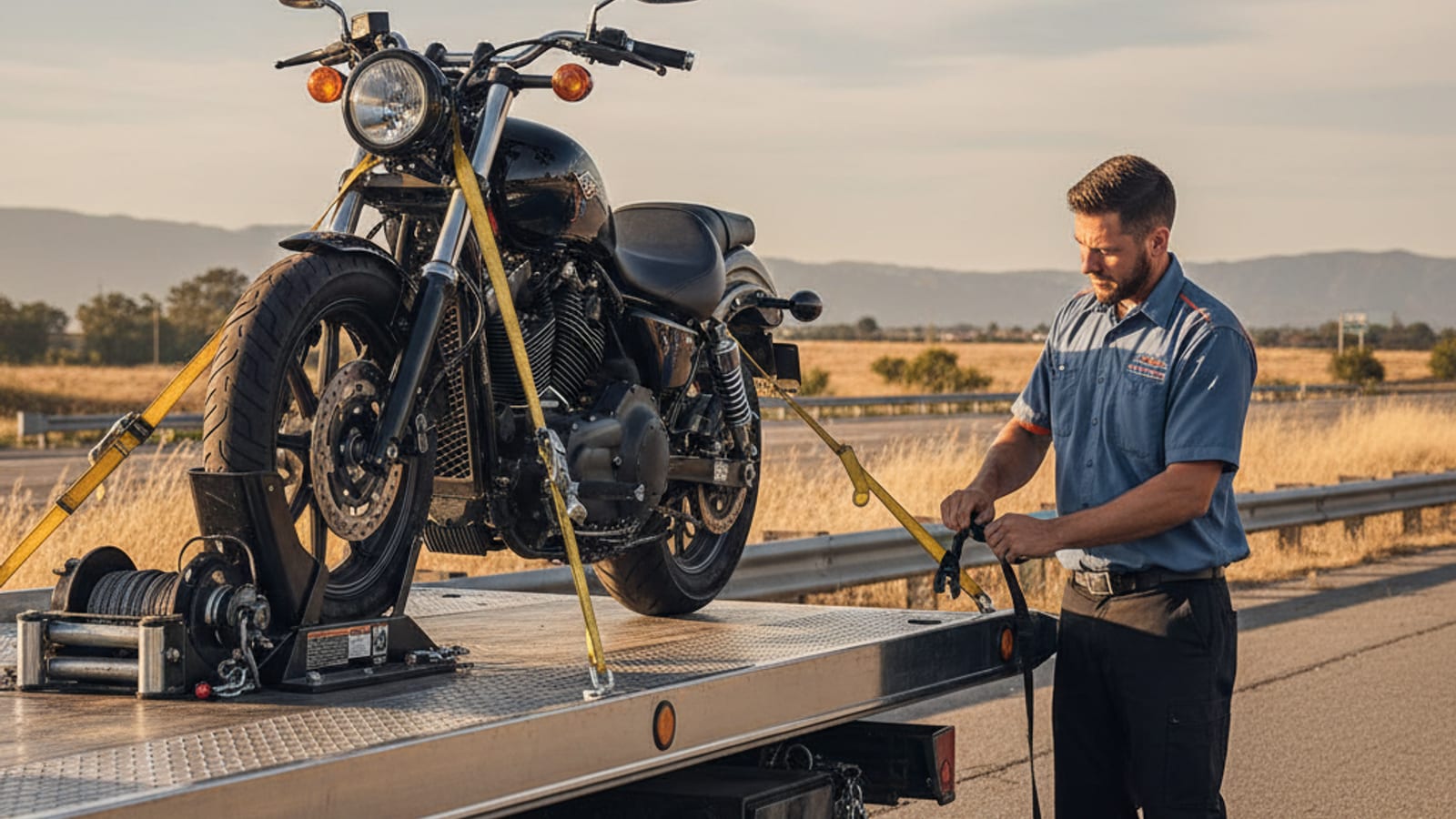
- A proper motorcycle tow requires a low-deck flatbed, a wheel chock for the front wheel, and soft tie-down straps at the handlebars and lower triple tree. Never chains, never frame hooks.
- Safe strap points: handlebars, lower triple tree, and front fork legs. Never strap to mirrors, exhaust, pegs, fuel tank, or fairings.
- Don’t restart a dropped bike that was on its side for more than 30 seconds; oil fouling can hydrolock the cylinder.
- Motorcycle tows in San Diego start at $105 local; canyon recovery and track-day transport are available with 48 hours notice.
A sloppy motorcycle tow can crack a fork tube, bend the triple tree, or scuff tank paint that costs $800 to refinish. Here’s how it should be done - and what to ask for on the phone.
What equipment should a motorcycle tow truck have?
A proper motorcycle tow uses three things:
- A low-deck flatbed (rollback with approach angle under 12 degrees) so the bike rolls on, not up a steep ramp
- A wheel chock bolted to the deck that cradles the front wheel upright
- Soft tie-down straps - two to four of them - anchored at the handlebars and the lower triple tree
That’s it. No chains, no frame hooks, no strap-to-fuel-tank-shortcut. A clean motorcycle tow takes 10-15 minutes and leaves zero marks.
Where should tie-down straps attach on a motorcycle?
Soft straps (synthetic, rated 1,500+ lb) can safely attach to:
- Handlebars - close to the triple clamp, outside the bar-end weights. One strap each side.
- Lower triple tree - the aluminum or steel part just below the steering head, above the fork tubes. Soft strap loops through the triple tree opening.
- Front fork legs - lower on the fork tubes, below the axle clamps. Works on naked bikes; skip on fully-faired sport bikes (scratches the fairing).
Where should straps never go on a motorcycle?
Do not strap to:
- Mirrors - will bend or break
- Exhaust headers - heat-cycle damage plus scratching
- Pegs or rearsets - will bend; not strong anchor points
- Fuel tank - dents under strap tension
- Plastic fairings - scratches and cracks
- Seats or cowl pieces - will deform
If a tow driver tries to strap to any of these, stop them and find a better driver.
Does the tow truck need a wheel chock?
The best motorcycle tows use a wheel chock - a U-shaped metal bracket bolted to the flatbed deck that holds the front wheel vertical. The bike rolls into the chock, which keeps it upright while the straps do their job.
If there’s no chock, the backup is a canyon dam strap system: a ratcheting strap that pulls the front wheel against a flat bar anchor. Works, but takes more time and experience to get right.
Never tow a motorcycle on its side stand or center stand alone. The stand isn’t designed for transport forces; bikes fall.
The loading procedure
A proper motorcycle tow:
- Flatbed deck tilted down to street level
- Driver or owner walks the bike onto the deck (transmission in neutral, engine off)
- Front wheel rolled into the chock
- First strap at front handlebar or triple tree - just snug, not cranked
- Second strap at opposite front side - matched tension
- Rear straps (optional for most bikes) - at the rear grab rail or subframe, soft only
- Driver checks the bike for lean - should be perfectly vertical or slightly forward
- Final tension on all straps - firm, not over-torqued. You want the bike held, not crushed.
- Deck raised to travel position
Total: 10-15 minutes on a standard cruiser, sport, or touring bike. Trikes and scooters take slightly longer.
What should you tell dispatch when calling for a motorcycle tow?
When calling for a motorcycle tow, tell dispatch:
- Type of bike - cruiser, sport, touring, adventure, dual-sport, trike, scooter
- Make and model - enough detail to judge size and any fairing considerations
- What happened - dropped on canyon road, mechanical, dead battery, accident
- Current location - mile marker, pin drop, or address
- Where it’s going - home, shop, dealer
Dispatch confirms the low-deck flatbed with wheel chock is coming and gives an ETA. A good shop tells you exactly what they’re sending.
Canyon road recovery
San Diego County canyon routes - Crest, Sunrise Highway, Palomar Mountain, East County canyons - eat motorcycles on weekends. We respond to canyon-road accident recovery calls constantly. Some specifics:
- Pin-drop location saves time. Canyon mile markers are far apart; a Google Maps pin drop via text is the fastest.
- Stay with the bike until the driver arrives. Walking to the nearest road sign costs time and sometimes makes you unreachable.
- Don’t try to restart a dropped bike that’s been on its side for more than 30 seconds. Oil fouling in the cylinder can hydrolock on a restart - a much more expensive problem than the tow.
- We can haul the rider and one passenger in most tow trucks. If you have riding partners, tell us; we’ll coordinate who rides with the tow and who follows.
Track day and event transport
For track days at Chuckwalla, Buttonwillow, or Willow Springs - or Barber Motorsports / Laguna Seca further out - scheduled long-distance flatbed transport works better than morning-of emergency calls. Book a few days ahead:
- One-way track transport out of SD: flat-rate quote, based on distance
- Round-trip track-day transport (we deliver and pick up): discounted bundled rate
- Multi-bike transport (2 bikes on one flatbed): shared rate
Call at least 48 hours out for best scheduling.
If you’re riding an electric motorcycle (Zero, Energica, LiveWire) and run out of range mid-ride, Charge Pro SD offers mobile EV charging across San Diego County - worth having their number saved alongside your tow company.
Should you ride home after dropping your bike?
If you dropped your bike on a ride and it’s rideable but damaged, the question is: ride it or tow it?
Ride it home if:
- Frame and fork are visibly straight
- Headlight and tail light work
- Brakes feel normal
- Tires are intact (no sidewall damage)
- No fluid leaks (oil, fuel, coolant)
Tow it home if:
- Any of the above is off
- You’re shaken and riding feels sketchy
- Fairings are damaged in a way that might interfere with steering
- The bike is leaking anything
We would rather tow a bike that could have been ridden than have you drop it a second time because you were still rattled from the first. The $125 is cheap compared to a second crash.
Bottom line
Low deck. Wheel chock. Soft straps at bars and triple tree. Never chains, never frame hooks, never straps on fuel tanks or pegs.
If the driver showing up doesn’t know these rules, call a different driver. Our motorcycle-specialist drivers know them by heart.
Motorcycle towing across San Diego County: Canyon recoveries in Alpine, Ramona, and Julian, plus city pickups in Downtown, La Jolla, and throughout the San Diego metro.
Related reading: Curious how flatbed and wheel-lift trucks differ beyond motorcycle use? Our flatbed vs. wheel-lift comparison covers the mechanics for all vehicle types. For a full look at what towing costs in San Diego County — including motorcycle-specific pricing — see the San Diego tow cost guide.
Frequently asked questions
How much does a motorcycle tow cost in San Diego?
Motorcycle tows in San Diego start at $105 for a local tow. Canyon road recoveries and longer-distance transport cost more depending on location and distance. Track-day transport is quoted flat-rate based on the destination.
Can a regular tow truck handle a motorcycle?
A standard flatbed can transport a motorcycle, but it needs a wheel chock and soft tie-down straps - not just chains or frame hooks. If the tow company doesn’t mention a wheel chock when you call, ask specifically. A driver without motorcycle-specific equipment shouldn’t be loading your bike.
Should I try to ride my motorcycle home after a drop?
Only if the frame and forks are straight, lights work, brakes feel normal, tires are intact, and there are no fluid leaks. If any of those are off - or if you’re shaken and don’t feel confident - call for a tow. The $125 is far cheaper than a second crash caused by riding rattled.
Why shouldn’t I restart a motorcycle that’s been on its side?
When a bike lays on its side for more than 30 seconds, oil can seep into the cylinder. Attempting a restart can hydrolock the engine - the piston tries to compress a liquid that doesn’t compress, which can bend a connecting rod. Let the bike sit upright for several minutes and check the oil sight glass before trying to start it.
Motorcycle tows from $105 local. Call (858) 923-5787 for canyon rescues, mechanical breakdowns, or track-day transport.