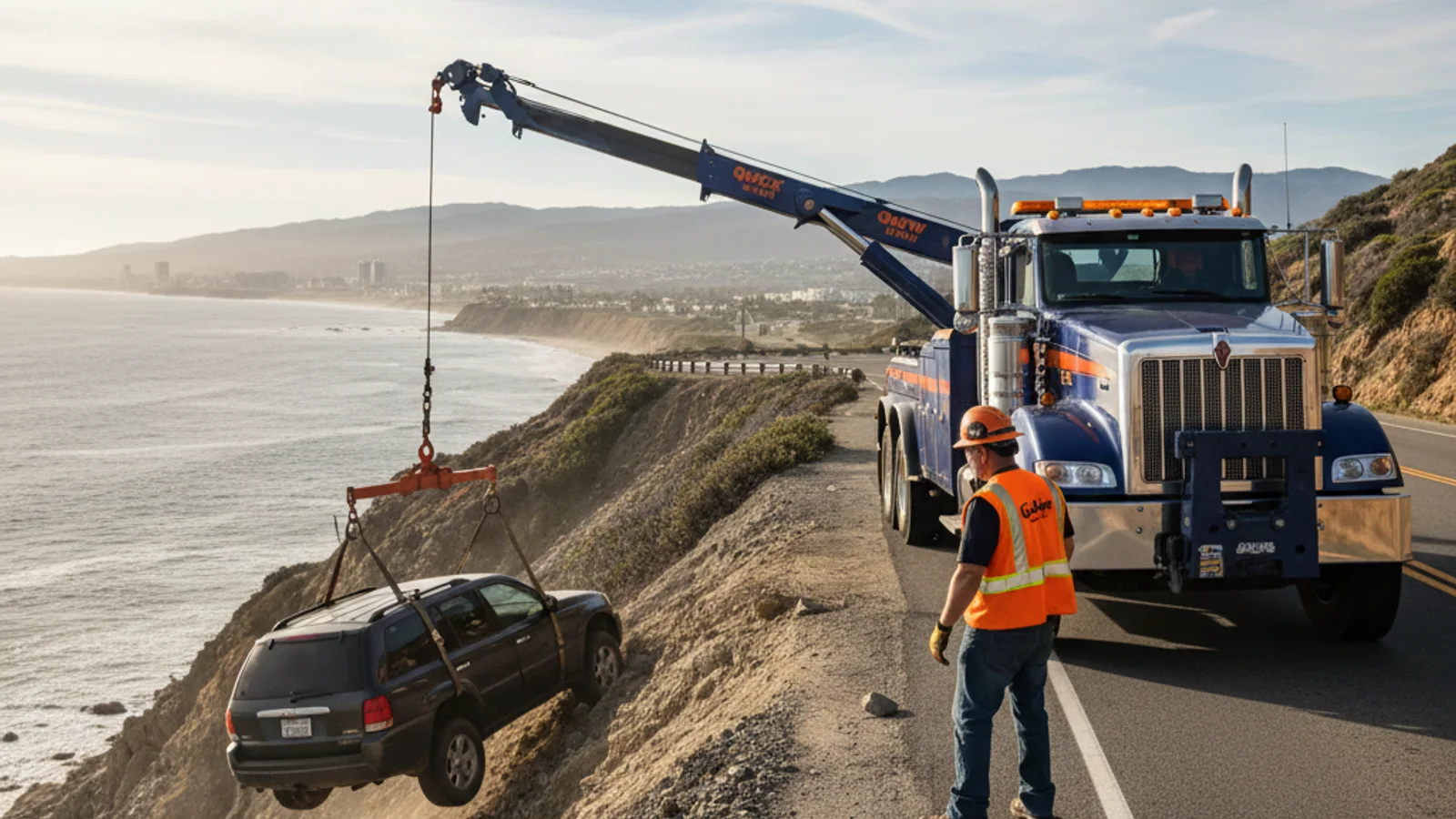
A widely watched recovery video from April 2026 showed a moving truck balanced over the edge of an embankment, looking like it was about to tip into a canyon. The recovery team had to rig multiple winches, stabilize the truck before any pulling, and extract it without letting it roll. This isn’t a wheel-lift job. It isn’t even a flatbed job. It’s heavy-duty rotator territory.
Quick Tow SD is a referral line. Independent operators who take heavy-duty work bring wreckers or rotators sized to the vehicle. This brand does not publish a 50,000 lb capacity as its own. The line takes calls 24/7, and the operator taking the job gives you an arrival estimate for your exact spot.
Edge recovery or oversized vehicle stranded? Call (858) 923-5787. The operator who accepts says whether they are bringing a wrecker, a rotator, or a specialty rigging crew.
Source: Matt’s Off Road Recovery, How Is This Not Tipping Over?! Moving Truck Hangs Over The Edge (April 2026)
TL;DR
- Edge recoveries are heavy-duty operations. The vehicle has to be stabilized BEFORE any pulling happens, otherwise it goes off the edge.
- The equipment required: a heavy wrecker or rotator, secondary stabilization rigging, and a crew that knows when to add anchors and when to pull.
- Common scenarios in San Diego County: I-8 grade descents, the canyon roads east of Alpine, SR-67 north of Lakeside, parking-structure ramps with steep angles, ranch driveways.
- The operator who accepts gives the arrival estimate after they know the pin. This page does not publish a recovery clock.
What was happening in the recovery?
A moving truck had gone off the road, but instead of falling fully into the embankment below, it was wedged against the edge with most of its weight cantilevered into open air. The driver had been able to get out. The truck and its contents were now in a slow-rolling situation: any movement risked tipping it the rest of the way.
The recovery team’s first move wasn’t to pull, it was to STABILIZE. They rigged a winch line to hold the truck in place. Then they rigged a second line, from a different anchor at a different angle. Only with two lines holding the truck in tension did they begin to actually pull it back onto solid ground. The whole operation took hours, not minutes.
The lesson for a stranded driver: when the vehicle is in a precarious position, the time to stabilize is BEFORE you try to move it. Calling the right crew with the right equipment matters more than calling fast.
Why isn’t this a normal tow truck job?
A light-duty wrecker is sized for cars. Hook it to a loaded 26-foot moving truck and the moving truck can outweigh the wrecker. The smaller truck is not the recovery tool.
A heavy-duty wrecker, by contrast, weighs tens of thousands of pounds empty and is built to move very heavy things safely. The operator who accepts quotes the truck they will send. Typical jobs that need that class:
- Class 7 and 8 box trucks (most moving trucks, including the largest U-Haul rentals)
- 30-foot and longer RVs
- Buses (school and city)
- Commercial delivery vehicles
- Construction equipment
- Tow trucks themselves when one of them goes down
A rotator, which is a heavy wrecker with a 360-degree rotating boom, adds the ability to lift and place a vehicle without dragging it. Critical for edge recoveries where dragging would tip the vehicle off.
Where in San Diego County do these recoveries happen?
Pins that fit this job: I-8 east of Alpine, SR-67 north of Lakeside, Sunrise Highway, parking-structure ramps, and steep ranch driveways in Ramona, Julian, or Valley Center. This page does not rank those pins by call volume.
If you’re moving and renting a 26-foot truck, the rule of thumb: if you wouldn’t drive a tractor-trailer down a road, don’t drive a 26-footer down it either. The two have similar turning radii and similar problems with low overhangs and crumbling shoulders.
What should I do if a moving truck or RV ends up in a precarious position?
In order:
- Get everyone out and away from the vehicle. A truck that LOOKS stable can shift in seconds.
- Don’t try to drive it forward or back. Movement is what makes it tip.
- Get a safe distance and call (858) 923-5787. Tell dispatch what the vehicle is (make, size, loaded weight if you know it) and exactly what its position is, “hanging off a 6-foot embankment with the back wheels on solid ground” is the kind of detail we need.
- Don’t let well-meaning passersby try to help. A pickup truck pulling on the back bumper of a moving truck that’s already balanced wrong is how the situation becomes worse.
- Photograph the position if it’s safe. Useful for insurance and for the operator who accepts to plan rigging.
Frequently asked questions
How much does heavy-duty edge recovery cost in San Diego?
Heavy-duty work is billed by the operator, with equipment specified. Ask for a written number on the call. This page does not publish an hourly rate card. Insurance often covers commercial recoveries, so your fleet manager or insurer should be involved as soon as the vehicle is stable.
Can a regular tow company do this?
Only if that company has the right equipment. Most San Diego County tow operators run light-duty and medium-duty trucks only. Heavy-duty work over 26,000 lb GVWR is specialized. This referral line matches an independent operator who says whether they can take that class. It does not claim a 50,000 lb house fleet.
What if my RV breaks down on the I-8 grade?
Same answer as the moving truck. Call (858) 923-5787, give the location and the RV class. Class A motorhomes are the heaviest passenger RV class and need heavy-duty equipment. Class B and Class C may roll on a lighter truck; the operator who accepts says if they need a heavier wrecker because of damage or a bad pin.
How long will the recovery take?
It depends on the rigging required. The operator who is on scene gives a realistic estimate after they see it. This page does not publish a 60-minute or multi-hour clock.
Is it safe to leave the cargo in a moving truck during recovery?
Sometimes. The operator on scene decides. If cargo would shift, they may unload first.
Last updated: May 14, 2026.
Heavy-duty recovery needed in San Diego County? Call Quick Tow SD at (858) 923-5787. The line takes calls 24/7. Ask the operator whether they are sending a wrecker or a rotator. This brand does not publish a GVWR capacity.