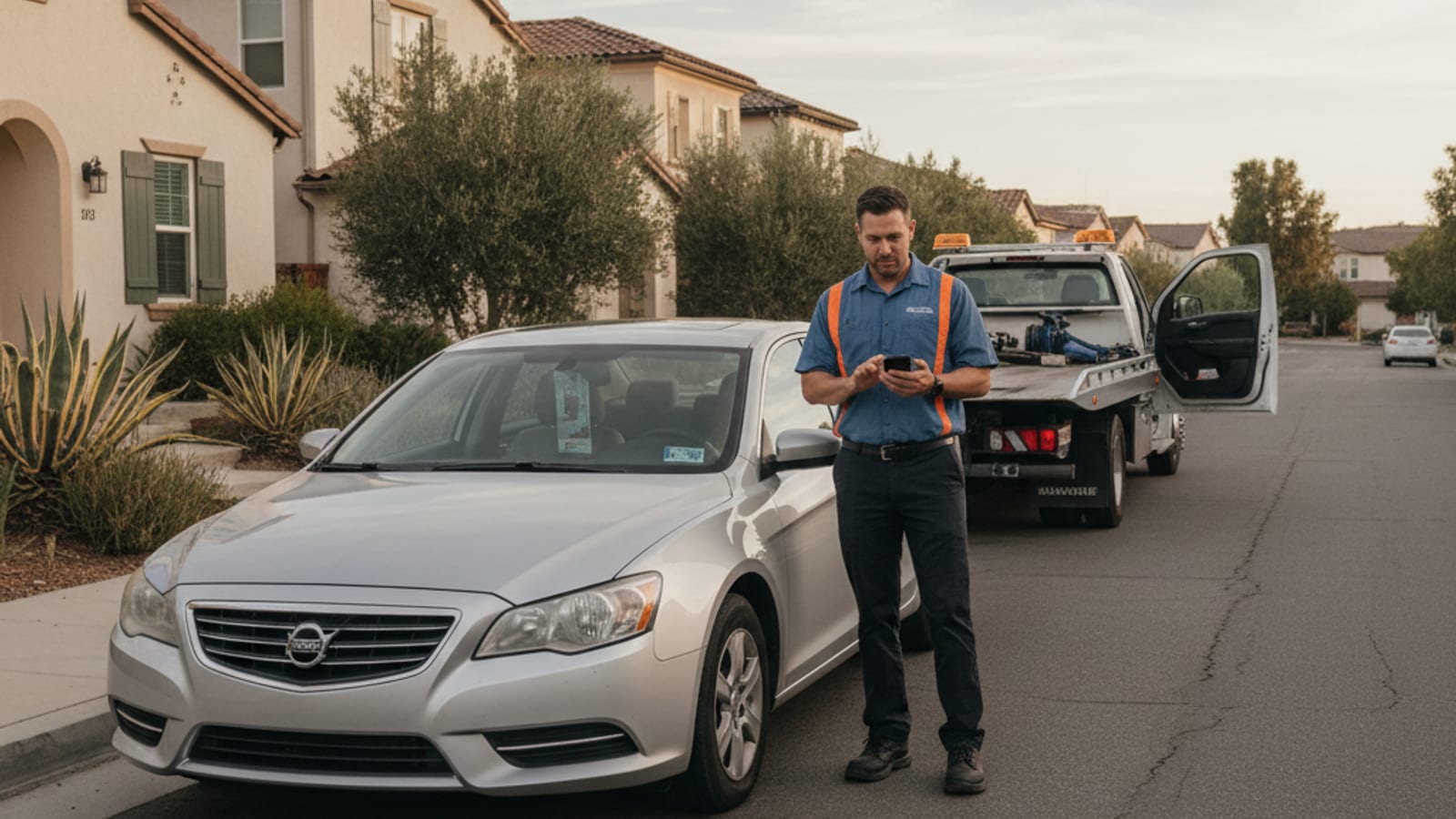
TL;DR
- The 7 red flags: won’t quote a price on the phone, shows up before you called, no DOT number or insurance proof, pressures you to sign paperwork, charges storage on day one, won’t name the truck type, and provides no photos or receipt.
- A reputable tow company quotes a flat rate before dispatch, sends the right truck for your vehicle, and photographs every pickup and drop-off.
- Vet a company in advance by checking their Google Business Profile (4.5+ stars), BBB rating (A or better), and whether they answer live 24/7.
- If you’re stuck right now, three quick checks: do they answer live, quote flat, and name the truck type? All yes means go.
The tow industry has a low barrier to entry and a lot of bad actors. Most cities have a few reputable companies and a long tail of one-truck outfits chasing scanner calls. Here’s how to tell the difference before you hand over your keys.
Red flag 1: Won’t quote a price on the phone
A reputable dispatcher will quote a flat rate based on:
- Pickup location
- Destination
- Vehicle year/make/model (determines truck type)
- Reason for the tow (mechanical, accident, property)
If the voice on the phone says “we’ll see what it is when we get there,” that’s a setup for price-gouging at the drop-off. The dispatcher knows the rates; if they won’t tell you, they’re planning to add charges later.
What to ask: “What’s the total flat rate for this tow, including all fees?” If they won’t give you one number, call a different company.
Red flag 2: Shows up at the scene before you called
In California, tow companies cannot legally solicit at accident scenes. But “chasers” do it anyway - they monitor police radio, show up before a tow is dispatched, and try to get you to sign paperwork on the shoulder while you’re rattled.
- If a tow truck arrives without you calling, say no.
- Wait for the tow you or your insurance dispatched.
- If CHP is on the scene, they’ll route the next legitimate tow through the rotation.
Hiring a chaser sets you up for jacked-up prices, unexpected charges, and sometimes vehicles held hostage for “storage fees” you never agreed to.
Red flag 3: No business address, no DOT number, no insurance proof
Legitimate tow companies have:
- A physical business address (not just a P.O. box)
- A US DOT number displayed on the truck
- Proof of insurance ($100K minimum cargo coverage, $1M liability)
- A CA CHP Motor Carrier Permit (required for all CA tow operators)
- California contractor licenses where applicable
Look at the truck when it arrives. A clean truck with legible company branding and DOT numbers is a good sign. An unmarked pickup with a magnetic sign is a red flag.
What to ask: “What’s your DOT number and MCP permit? Can I see proof of insurance before you load?” A legit operator will show you. A chaser won’t.
Red flag 4: Pressuring you to sign paperwork at the scene
You shouldn’t need to sign anything at the scene except:
- A simple service authorization (your name, signature, destination)
- A photo release acknowledgment (some companies ask)
Anything longer - terms of service, credit card authorization with amount blank, or anything with unclear language - is a red flag.
What to do: Read before signing. If they pressure you, slow down. A real tow company will wait for you to read.
Never sign a blank credit card form or one with unclear totals. The number you sign is the number you pay.
Red flag 5: “Storage fees” starting day one
CVC 22658 specifies:
- Release during normal business hours, Monday through Friday, 8 a.m. to 5 p.m., except state holidays
- Payment by valid bank credit card or cash, so cash-only isn’t compliant
- If the vehicle is released within 24 hours, only one day of storage may be charged
- An after-hours gate fee is capped at one-half of the hourly tow rate charged for the original tow
There’s no dollar cap on release fees. A charge is excessive when it exceeds what the law enforcement agency with primary jurisdiction would have been charged for the same job, so ask what that agency’s approved rate is rather than trusting a quoted “legal maximum.”
If a company charges a second day of storage on a same-day release, demands cash only, or refuses to release during business hours, you can dispute the charges through the CHP complaint line, the Bureau of Automotive Repair, or Small Claims.
Keep every receipt. Document every phone call. If charges seem excessive, you have recourse.
Red flag 6: Won’t tell you which truck is coming
Different situations require different trucks:
- Flatbed for AWD, EV, luxury, damaged, or low-clearance vehicles
- Wheel-lift for standard FWD/RWD in tight spaces
- Heavy-duty wrecker for box trucks, RVs, and commercial vehicles
- Low-clearance flatbed for exotic, classic, and lowered cars
A reputable dispatcher confirms which truck is coming and why. If the answer is vague - “whatever’s closest” - that’s a recipe for the wrong truck showing up and either doing the job poorly or demanding extra for a second trip.
Ask: “What type of truck are you sending, and why is that the right choice for my vehicle?”
Red flag 7: No photos, no documentation, no receipt
Every legitimate tow includes:
- Photos of the vehicle at pickup (all four sides) and drop-off
- A written or digital receipt with date, time, pickup address, destination, fees, and driver name
- A service authorization with clear scope
- A release form if going to impound with a spelled-out release procedure
If the driver just loads and drives without any of this, you have no evidence if something goes wrong later. Damage disputes, missing items claims, or insurance reimbursement all depend on this paperwork.
Ask at the scene: “Are you photographing the vehicle? Can I get a copy?” Every pro tow company says yes.
What are the green flags of a good tow company?
The opposite of each red flag above:
- Flat-rate quote on the phone before dispatch
- Answers the phone live, 24/7 - not voicemail
- Clearly branded truck with DOT and MCP numbers displayed
- Named driver who introduces themselves
- Readable paperwork with all totals filled in
- Photos of every pickup and drop-off
- Proper truck for the vehicle - flatbed for AWD/EV, wheel-lift for standard
How do you vet a tow company before you need one?
Ten minutes now saves hours later.
Check their Google Business Profile:
- Physical address displayed
- Phone number that matches the website
- Reviews: 4.5 stars or better with recent reviews
- Read the 1-star reviews for patterns (price gouging, no-show, damage complaints)
Check their website:
- Clear pricing structure
- Specific services described
- Company history and owner info
- Contact form and phone number
Check their BBB rating:
- A+ or A is the floor
- Read complaints - patterns matter more than individual gripes
Call them and ask questions:
- “What’s your MCP number?”
- “Do you provide written flat-rate quotes?”
- “Do you photograph pickup and drop-off?”
- How they answer tells you how they operate
What if you’re already stuck and need a tow right now?
If you’re on a shoulder right now and need a tow, you don’t have time for 10 minutes of vetting. Quick triage:
- Does a dispatcher answer the phone live? Yes = probably fine, No = next company
- Do they quote a flat rate? Yes = probably fine, No = hang up
- Do they name the truck type they’re sending? Yes = probably fine, No = ask again
If all three are yes, go with them. If any are no, call the next company on your list.
Bottom line
A good tow company is boringly predictable. They answer the phone, quote flat, send the right truck, photograph the load, provide a receipt, and release the vehicle when you come to collect it. No drama, no surprise fees.
Bad tow companies are unpredictable: no phone quote, wrong truck, mystery charges, vehicle held hostage. Every red flag above is a symptom of a business that makes money on confusion.
One more thing worth knowing: not every roadside situation needs a tow truck. EV drivers who run out of charge can often avoid the flatbed entirely by calling Charge Pro SD for mobile charging instead.
We serve all of San Diego County: Downtown, La Mesa, National City, Poway, Carlsbad, and every city in between.
Related reading: Once you’ve found a company you trust, the next question is price — our San Diego tow cost guide covers what to expect so you can gut-check any quote. If you manage a property with parking enforcement, our CVC 22658 compliance guide explains the legal requirements for private-property towing in California.
Frequently asked questions
How do I verify a tow company is licensed in California?
Check for a CHP Motor Carrier Permit (MCP) number and a US DOT number displayed on the truck. You can verify the MCP through the CHP website or call the CHP commercial vehicle section. A legit company will provide both numbers on request.
Can a tow company hold my car hostage for unpaid fees?
They can hold the vehicle for legitimate tow and storage fees, but they must release it during normal business hours and accept at least one non-cash payment method. If fees seem inflated or they refuse to release during business hours, file a complaint with the CHP and dispute through Small Claims Court.
What’s a fair price for a local tow in San Diego?
Standard light-duty local tows in San Diego run $95-$175 flat-rate for the first 5-10 miles. Flatbed tows start around $115. Any quote significantly above this range for a basic local tow deserves a second opinion.
What should I do if a tow truck arrives at an accident without being called?
Don’t hire them. In California, it’s illegal for tow companies to solicit at accident scenes. Wait for the tow dispatched by your insurance or CHP rotation. If you feel pressured, tell the responding officer.
Our standard: flat-rate on the phone, a real arrival estimate instead of a script, the right truck for your vehicle, and a written receipt every time. If that’s the bar, save our number. If you’re comparing options, ask the same questions of anyone else - and hire the company that answers them directly.